Vol. I  ·  No. 71
Sunday, November 22, 2026  · 
🔍 Search  ·  451 stories in the archive

Front page › Field Notes

Field Notes

4 stories in the archive, newest first

Field Notes

Driving to the Mountains for Thanksgiving: Know Your Chain Rules First

The first big Sierra storm of the season lands just before the busiest travel week of the fall. A few minutes of reading now saves an hour on the shoulder later.

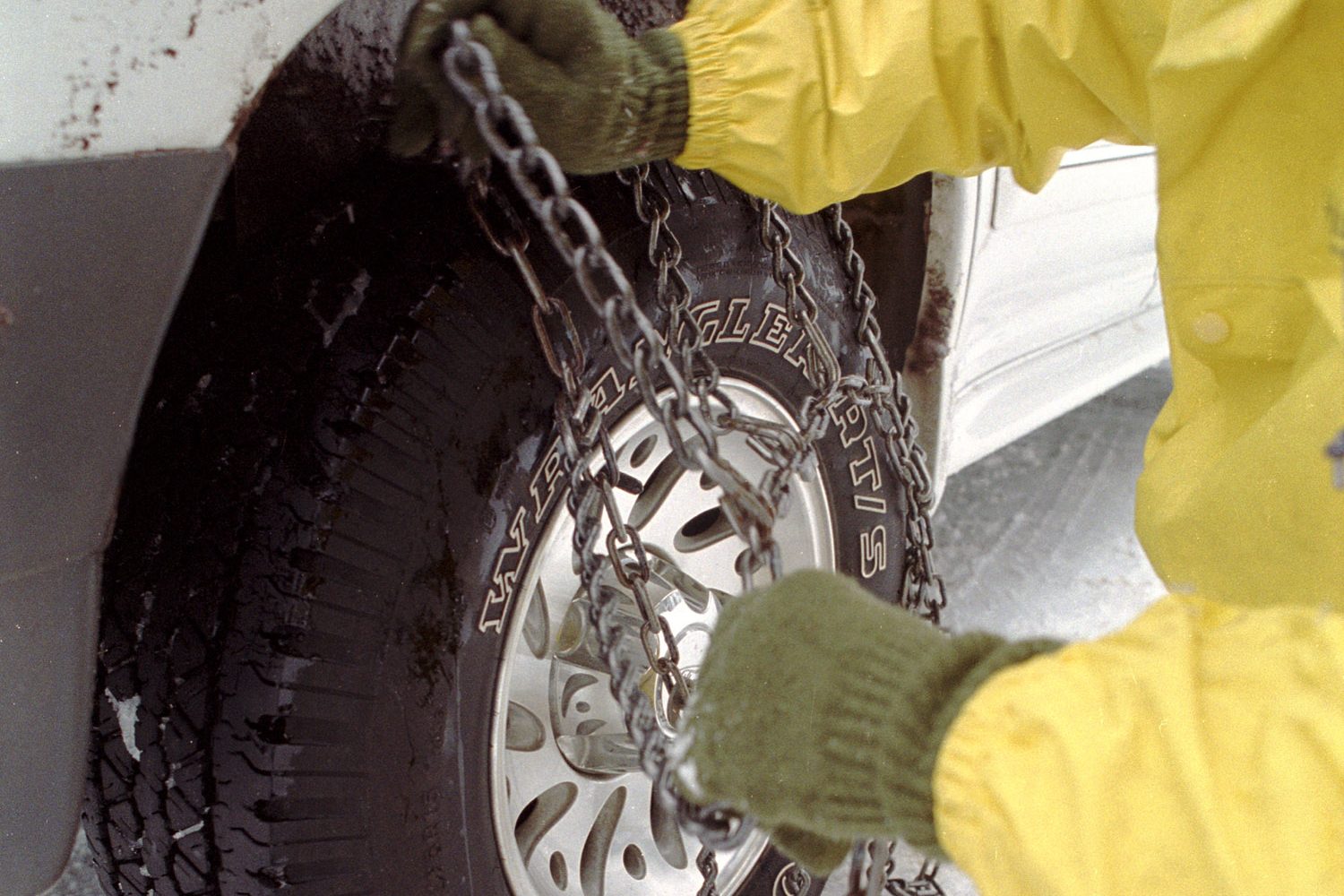
Gloved hands in a yellow rain jacket fit a tire chain over the wheel of a white pickup standing in snow.
File photo from the Oregon Department of Transportation, dated November 2004: fitting a chain to a pickup's tire in the snow. Photo: Oregon Department of Transportation, CC BY 2.0, via Wikimedia Commons

This week's Sierra storm is a preview of what holiday travel into the mountains looks like: winter storm warnings, chain controls on the passes and a line of cars on the shoulder of the highway while drivers try to figure out their chains for the first time. Most of that is avoidable with a little preparation before you leave the house.

Start with the rules. In California, Caltrans posts three levels of chain control. Under R-1, chains are required, but passenger vehicles and light trucks under 6,000 pounds can go without them if they have snow tires on at least two drive wheels. Under R-2, four-wheel and all-wheel drive vehicles with snow-tread tires on all four wheels are exempt; everyone else needs chains or traction devices. Under R-3, every vehicle needs them, with no exceptions, and Caltrans says the road is often closed before it gets to that point.

The part people miss: even when you are exempt, you have to carry chains. Caltrans says vehicles using snow tires under R-1 must carry chains, and four-wheel and all-wheel drive vehicles must carry traction devices in chain control areas. An all-wheel drive car with no chains in the trunk is one condition change away from being turned around.

Practice once in the driveway, in daylight, with dry hands. The first time you fit chains should not be in slush, in the dark, with trucks going by. When the signs say chains are required, Caltrans says you will usually have about a mile before the checkpoint. Pull completely off to the right; do not stop where you block traffic. The speed limit with chains on is 25 or 30 mph. If you pay a roadside chain installer, get a receipt and note the badge number: installers are independent businesses, not Caltrans employees, and they are not allowed to sell or rent chains.

Then pack the car as if you might sit still for a few hours. Ready.gov's car kit list is short: jumper cables, flares or a reflective triangle, an ice scraper, a phone charger that plugs into the car, a blanket, a paper map, and cat litter or sand for traction. Add water, snacks, warm layers and a flashlight for everyone in the car. Keep the gas tank full, which also helps keep the fuel line from freezing, and turn off cruise control on snowy or icy roads.

Last, check before you go and again on the way. Conditions change quickly on mountain passes. Caltrans QuickMap and the CHIN line at 800-427-7623 show current chain controls and closures in California; other states run their own 511 systems. Ready.gov's advice for bad weather is the simplest of all: drive only if you really have to. Leaving a day early, or a morning late, is often the best piece of winter gear there is.

Sources

Field Notes

A Kit Is Not a Plan: Run the Scenarios Before You Need Them

Supplies are half of it. The other half is sitting down and asking what happens when the backup fails, the battery dies or the person who knows how is not home.

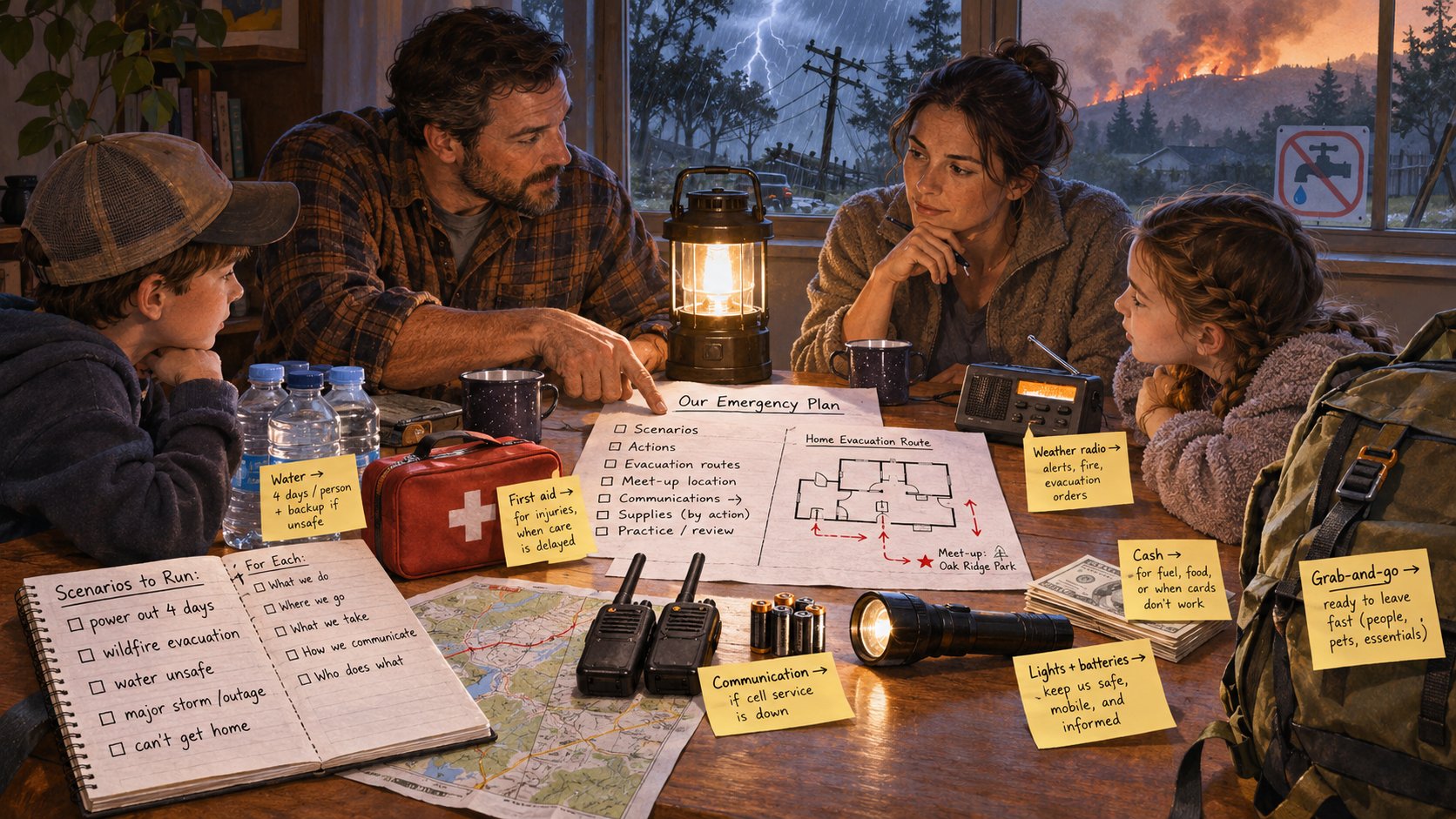
Painted illustration of a family at a lantern-lit table going over an emergency plan, with a scenario notebook, home evacuation map, first aid kit, water, radios, flashlight, cash and a go-bag, as a storm and a wildfire show through the windows.
AI-generated editorial illustration of a family running through its emergency plan. Illustration

Last month's Field Notes was about the supplies: water jugs, canned food, a grab-and-go bag. This one is about what comes next, and it costs nothing. Preparedness is not just owning the gear. It is walking through how you would actually use it, on a bad day, with the power out and half the household somewhere else, and finding the holes while it is still calm.

The method is simple. Pick a scenario. Say it out loud: the power is out for four days in January. A wildfire warning gives us fifteen minutes. The water company says not to drink from the tap. Then go down the list of what you are counting on and ask one question about each item: what if this does not work? Most plans fail at an assumption nobody noticed they were making.

Take water. A backyard pool looks like thousands of gallons of insurance, and for some jobs it is. Pool water can flush toilets, wash hands and clean up. But it is not drinking water. The CDC says to use pool water for swimming, not drinking: the chlorine, stabilizers and algaecides that keep it clear are not meant to be swallowed, and the water collects whatever blows into it. Now run it further. A wildfire drops ash in it. A chemical spill or a radiation release puts contamination on everything outdoors, and the CDC notes that boiling water does not remove radioactive material; until water is tested, sealed bottled water is the only supply known to be clean. That is the point of the exercise. The pool is a backup for washing, not a reason to skip the cases of drinking water in the garage.

Do the same with every source you are counting on. If you have a well, the pump almost certainly runs on electricity. A water heater holds clean water, but do you know where the drain valve is, and do you have to shut off the gas or power to it first? Gas stations need electricity to pump, so the generator plan depends on fuel you already have, stored safely and rotated. Card readers and ATMs go down with the grid, so the cash in the bag matters. Cell towers have limited backup power and get overloaded in a disaster, so the plan that starts with call each other may stall at step one.

Then look at the house itself. If the garage door opener has no power, does everyone know how to pull the manual release, and can they lift the door? If someone in the house takes a medication that needs refrigeration, how long does it last, and where is the cooler? If you heat with a generator or a camp stove, the carbon monoxide risk goes up: Ready.gov says to keep generators outdoors and away from windows, never in a garage, and to put battery-backed carbon monoxide alarms on every level of the home. If the plan is to drive out, is there a second route if the first is closed, and is the tank kept above half when fire season or a storm is coming?

Now the people. It is easy to build a plan around one person who knows where everything is and how it works. Ask what happens if that person is at work, stuck on a closed highway or hurt. Everyone old enough should know where the water and food are, where the gas and water shutoffs are, how to start the generator and where the bag is. If kids are at school, know the school's plan; in some emergencies, including a radiation release, officials tell parents not to go get them, because staying inside is safer than being out on the road.

The same thinking applies if you keep a firearm for home defense. Owning one is a start, not a plan. Have you practiced at a range recently, and have you done dry-fire practice at home, with the gun confirmed unloaded and no ammunition in the room? Has your spouse or partner practiced too, so they can safely handle it if you are not there or cannot get to it? Run the full sequence the way it would actually happen: woken up at 3 a.m., in the dark, getting to the safe, opening it, and doing it while managing kids or a phone call to 911. If the safe is a keypad or fingerprint model, when did you last change the battery, and does everyone who needs to know the code or have the backup key? Know what is behind every wall in the house, because a round that misses keeps going. And keep it locked whenever it is not in your direct control. Project ChildSafe, a program of the firearms industry trade group, has storage options and free cable locks through local law enforcement.

Communication is where a written plan earns its keep. Family Radio Service walkie-talkies need no license and share 22 channels with GMRS, which does need an FCC license for its higher-power use. Batteries are the limit, so do not leave radios on all day. Agree on a primary channel and a backup channel in case the first one is busy. Set check-in times: for example, radios on for ten minutes at the top of the hour at 8 a.m., noon and 6 p.m. Decide how many days that schedule holds and what it switches to as batteries run low, maybe once a day at noon. Write the channels, the times and an out-of-area contact on a card in every bag and every car, because nobody remembers channel numbers under stress. Test it once on an ordinary weekend to see how far the radios actually reach in your neighborhood.

Run the big scenarios too, even the ones that feel far-fetched. A long grid outage. A major earthquake. An attack or a nuclear incident. You do not need a bunker for these to be worth thinking about. Federal guidance for a radiation emergency is three steps: get inside, stay inside, stay tuned, ideally in a basement or the middle of a sturdy building, for at least 24 hours unless officials say otherwise. Thinking it through now tells you which room you would use, whether you have a battery or hand-crank radio to hear instructions, and whether there is enough water inside the house rather than in the backyard.

A good way to start is a tabletop drill. Sit down for half an hour with whoever lives in the house and talk through one scenario start to finish. Write down every point where someone says we would just. Those are the holes. Fix one or two, then pick a different scenario next month. Once a year, try a lights-off evening: flip the main breaker, or just do not use anything that plugs in, and see what you reach for that is not there.

None of this is about expecting disaster. It is the same habit anyone who spends time outside already has: checking the weather, telling someone your route, carrying the extra layer. You do it so the day goes fine. A shelf of supplies is a good start. Knowing what you will do with it, who does what and what to try when the first plan fails is what makes it a plan.
Sources

Field Notes

Before You Paddle Out in a Big Swell, Check for Rip Currents

The National Weather Service's basic advice: read the beach forecast, ask a lifeguard and remember that calm days can be dangerous too.

With high surf and rip current warnings up along much of the California coast and in Florida, Texas and Puerto Rico this week, the National Weather Service's rip current guidance is worth a reread before heading into the water.

Check conditions before you go: look at the local beach forecast before leaving home and talk to the lifeguard when you arrive. Swim at beaches with lifeguards; the U.S. Lifesaving Association puts the chance of drowning at a guarded beach at 1 in 18 million, the weather service says.

Do not assume good weather means safe water. The agency notes that rip currents often form on calm, sunny days, and that rip currents are not the only hazard: large waves can knock people down or pull them off beaches and rocks, which is why it tells beachgoers never to turn their back on the ocean.

Current alerts for any stretch of coast are listed on the local weather service office's page and on Outdoor Unc's surf stories, which carry the agency's advisory dates.

Sources

Field Notes

Emergency Preparedness Starts on a Calm Day, Not in the Storm

Field Notes is where we write with a looser hand. This one is about water jugs, canned soup, a small grab-and-go bag, and getting ready for a day you hope never comes.

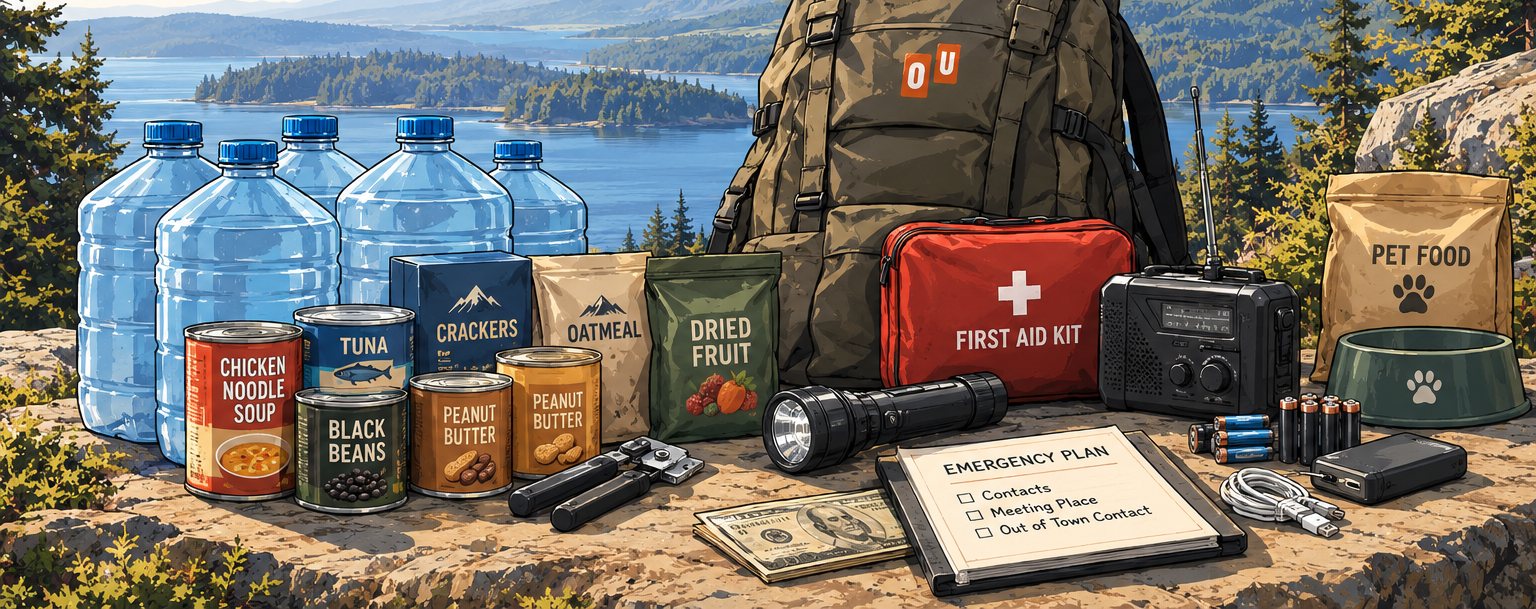
Illustration of emergency supplies laid out on a rock above a mountain lake: large water jugs, canned soup, tuna, black beans and peanut butter, crackers, oatmeal, dried fruit, a manual can opener, a backpack, a first aid kit, a flashlight, a hand-crank radio, batteries, a power bank, cash, an emergency plan binder, pet food and a pet bowl
The basics of a home emergency supply, from water and canned food to a radio, first aid kit and a written plan. Outdoor Unc illustration

Most of what we call preparedness is just doing a little thinking on a quiet day. When the power is on, the roads are open and the forecast is clear, it is easy to decide what you would want on hand if any of that changed: if the lights went out for three days, the water main broke, a winter storm closed the roads, or a wildfire warning gave you fifteen minutes to leave.

Getting ready is not the same as expecting the worst. We buy insurance for the same reason, not because we want to use it but so it is there if we do. A few jugs of water and a shelf of canned food work the same way. If you spend time outdoors you already think like this: you pack a rain shell under a blue sky and carry more water than the trail sign suggests.

None of it has to be packed into one box. Most households split it two ways. The bulky things, water and food, live where you have room: a pantry shelf, a closet corner or a spot in the garage, away from heat and direct sun. The small essentials go in a grab-and-go bag you can pick up on the way out the door.

Start with water, because you need it first. Ready.gov, the federal government's preparedness site, recommends at least one gallon per person per day, for drinking and basic sanitation, for several days. The Red Cross suggests a three-day supply if you have to leave and two weeks' worth if you stay home. For a family of four, two weeks is 56 gallons, which is a stack of cases in the garage, not a project. Store-bought bottled water keeps until its date; if you fill your own containers, use clean food-grade ones and replace the water every six months.

Then food that needs no refrigeration and little or no cooking: canned soups, beans, tuna and chicken, peanut butter, crackers, oatmeal, dried fruit, shelf-stable milk. The Red Cross plans for the same three days and two weeks as water. Buy what your household already eats and keep it with your regular groceries, so it rotates into dinners before it expires instead of going in the trash. And keep a manual can opener with it. It is the most forgotten item on every list.

The grab-and-go bag holds what you would want if you had to leave in a hurry: a flashlight and spare batteries, a battery or hand-crank radio that receives NOAA weather alerts, a first aid kit, a seven-day supply of any medications, copies of IDs and insurance papers in a waterproof pouch, some cash in small bills, a phone charger and power bank, and a few days of food and water you can carry. Add what your pets need. Ready.gov and the Red Cross both publish full checklists.

You do not have to do it in one weekend or spend much. Add a case of water to this week's grocery run and a few cans the next. Write your household's meeting place and an out-of-town contact on a card and tuck it in the bag. Twice a year, when the clocks change, check the dates and swap anything close to expiring into a meal.

Most of us will go years without needing any of it, and that is the best possible outcome. The supplies are not a prediction. They are a decision you make on a calm day, so that if the lights go out, the people in your house are not starting from zero.

Sources